Horus / Mission continuity
The mission survivesthe handover.
Mission memory for mixed robotic teams. Horus keeps source, uncertainty, structure, and human judgment inspectable when machines and operators change.
- Structure
- B-12
- Inspectable layers
- 03
- Bounded rooms
- 15
Public proof / representative prototypeB-12
Fictional dataset
SITUATION ROOMoperations / LEVEL 02
ONE ROOM / TWO SOURCE CLAIMS
01 / THE FAILURE MODE
A robot can leave the mission.
Its context should not.
Horus preserves what was observed, who reported it, how reliable it was, where sources disagree, and what a human authorized next.
OBSERVE→RECONCILE→TRANSFER
Context
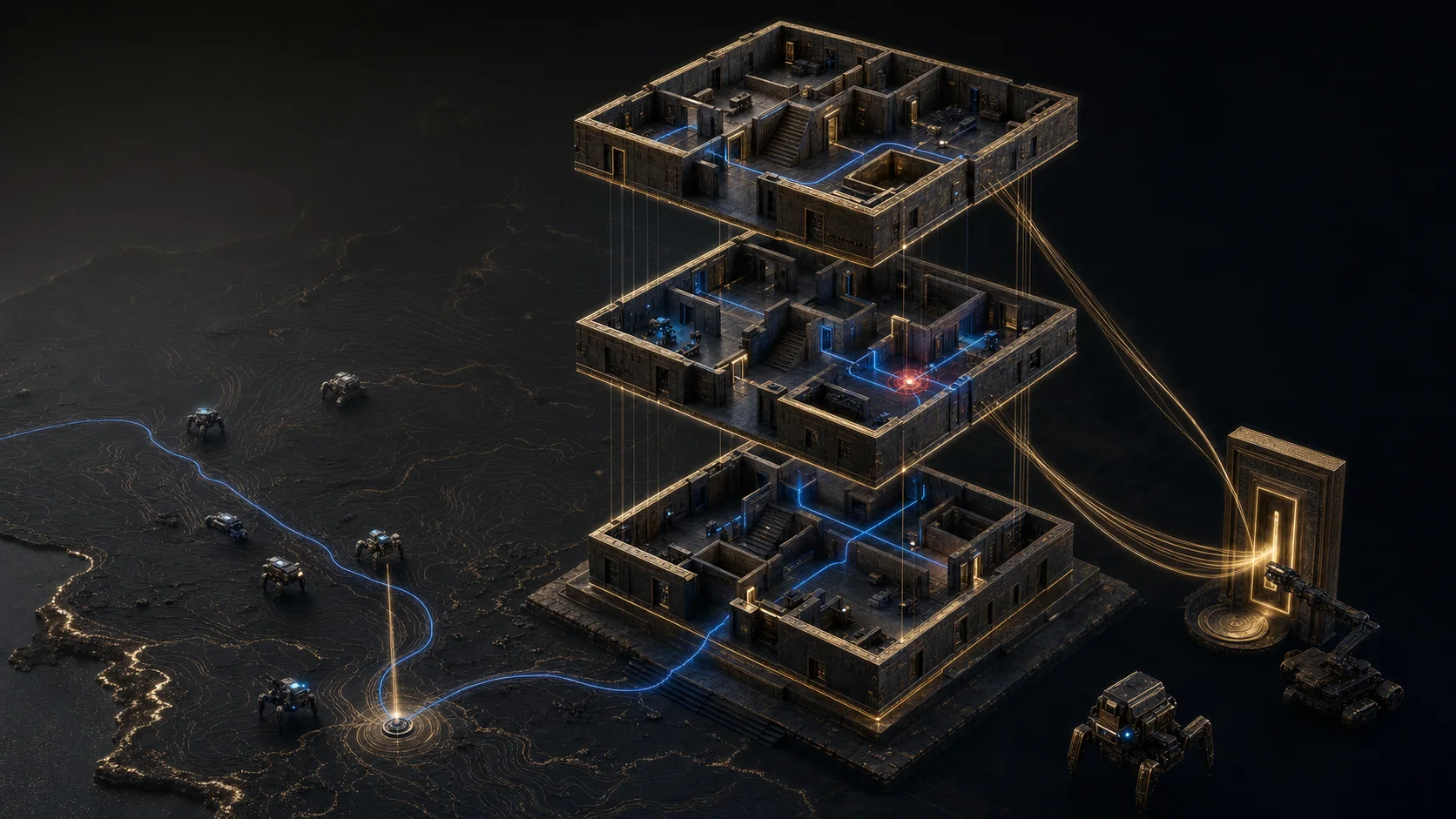
Context survives every change of scale.
An observation keeps its source, confidence, location, and freshness as a fictional site-local frame narrows from theater to representative B-12—without inventing geodetic certainty.
FICTIONAL SITE-LOCAL / B-12 / PROVENANCE ATTACHEDDeconstruct
The structure becomes navigable memory.
Exact representative plates, rooms, walls, doors, and vertical cores separate into a shared operational model.
3 FLOORS / 15 ROOMS / BUILDING-LOCALConflict
Disagreement remains visible.
UAV-01 reports no movement. SCOUT-02 reports a thermal change in the same room. Horus preserves both claims.
B12-2E / SOURCE CONFLICT / REVIEW REQUIREDHuman authority
Software recommends. A human decides.
Horus assembles mission memory and a bounded recheck route. Consequential change stops at the human gate.
UGV-03 RECHECK / AWAITING AUTHORITYHandoff
The incoming unit starts with context, not zero.
After explicit authorization, the representative context package transfers to UGV-03, then resolves into the approved static Horus prototype capture—not a live product connection.
SCOUT-02 → UGV-03 / HUMAN-GATED TRANSFER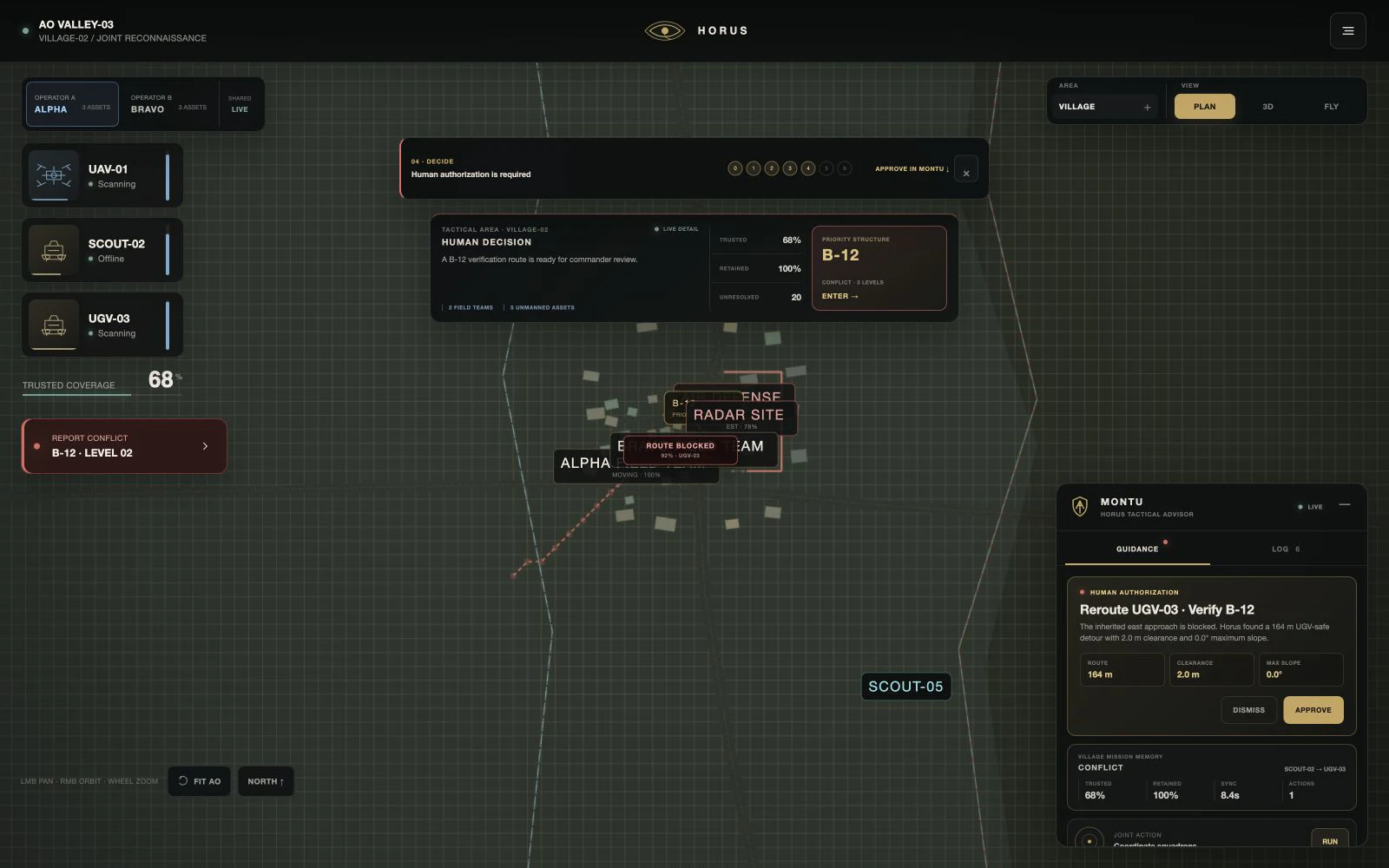
One continuous mission
Memory moves.
The mission does not reset.
0105
Context
Context survives every change of scale.
An observation keeps its source, confidence, location, and freshness as a fictional site-local frame narrows from theater to representative B-12—without inventing geodetic certainty.
FICTIONAL SITE-LOCAL / B-12 / PROVENANCE ATTACHED02 / THE OPERATING PRINCIPLE
Horus
One mission picture.
Human authority intact.
Horus is a defensive ISR mission-continuity layer for mixed robotic teams. It turns isolated observations into durable, inspectable mission memory—without pretending recommendation is command.
Current softwareHorus V2 / functional prototype
Runs the deterministic fictional mission locally in the browser. No production backend or live mission data.
Preserves
Context, source identity, confidence, conflict, and the human decision that changed the mission.
Demonstrates
A functional prototype spanning B-12 inspection, bounded recheck, authorization, and cross-asset handover.
Not claimed
Live mission data, field validation, operational deployment, certification, or autonomous engagement.
Functional software prototype · approved static capture · deterministic fictional scenario
03 / ENTER HORUS
Functional software prototypeThe spatial picture resolves into software.
The current Horus proof uses representative mission data. The approved capture shows the same B-12 conflict and bounded recheck at the human gate—then the guided browser prototype lets you inspect the complete handover.
Demonstrated
Enter guided Horus V2 Functional software prototype with deterministic representative scenarios.
Not claimedBattlefield validation, operational deployment, certification, or autonomous engagement.
04 / OPEN CHANNEL
Bring us the mission
that cannot lose its memory.
Partner, investor, or technical collaborator—open a direct briefing channel with Mashina Robotics.
Request a briefing hello@mashinarobotics.com